
Inside an Interactive IFS Group - Maren’s Story
Jay Earley, PhD
Interactive Group Institute
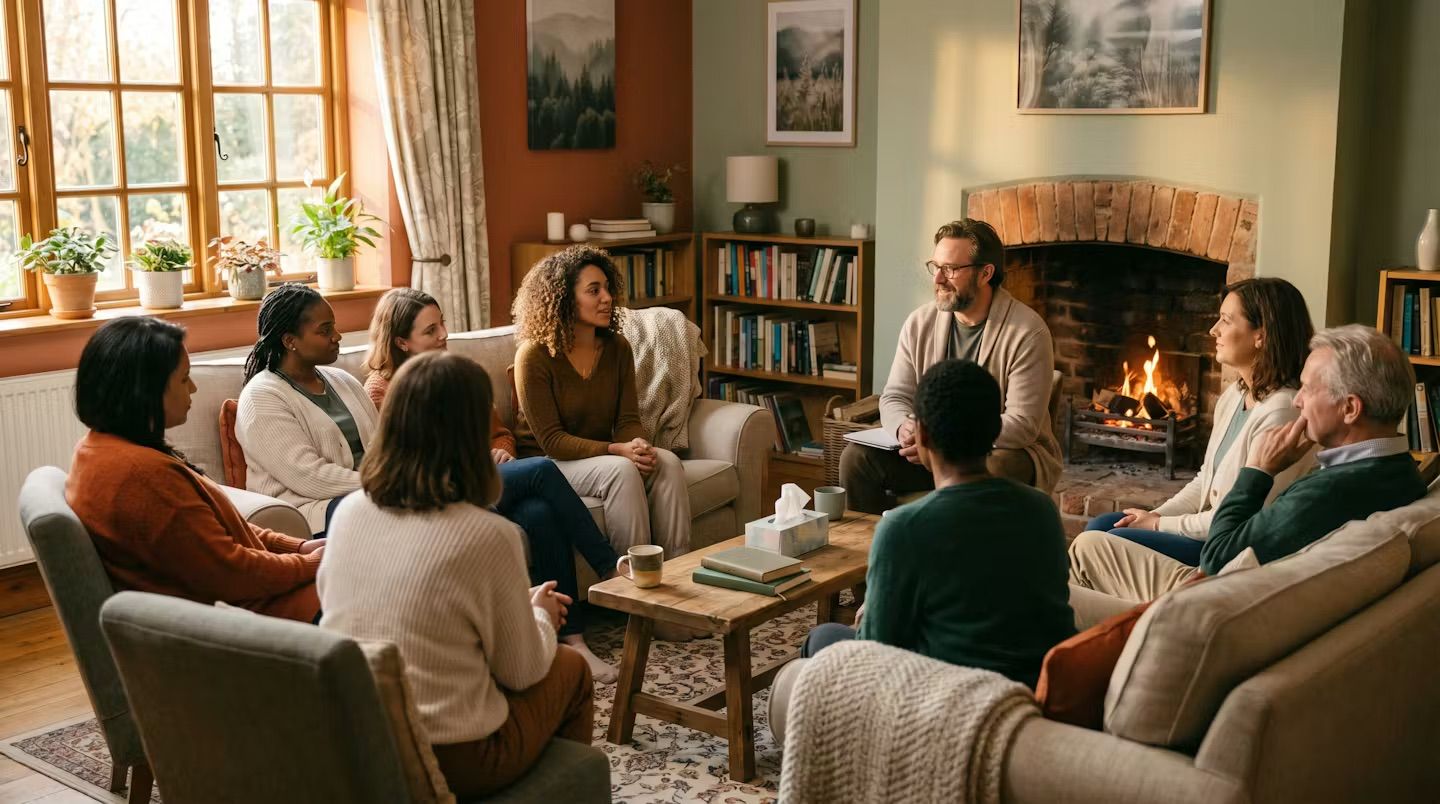
This story follows one fictitious member of an Interactive IFS Group over the course of a year. While it focuses on Maren’s experience, every member of the group is on their own journey as well.
Over the coming months, we’ll publish a series of stories from the perspectives of the other group members. Together, they offer a wider view of how individual growth and group development unfold side by side.
What Maren found in the group
Maren was forty-six, a hospice nurse, married twenty years to a kind and slightly oblivious man named Doug, and the mother of two teenagers who loved her in the way teenagers love a mother: as a stable background condition. She joined the group because she was tired. Tired of not having her feelings or needs matter.
She was beginning to say this out loud to herself and to her best friend. She had read about interactive groups online late one night and signed up before the part of her that managed everyone's comfort could intervene.
The first weeks
In her first three sessions, Maren was an excellent group member. She listened beautifully and took care of people. When Maren was taking care of someone, the group leader, a woman named Naomi, said, "Maren, I've been noticing how skillfully you take care of everyone here. I wonder if you want something for yourself." Maren laughed a small polite laugh and said something about being a nurse, but then something shifted in her.
"I'm tired," she said. And then, surprising herself: "I'm so tired."
"Tell us," Naomi said.
"I don't — " Maren stopped herself after only a couple words. She was looking down, hesitating, and then after a few moments she looked up and across the room.
Naomi: "Maren. Stay with me. What's happening right now?"
Maren: "Well, I’m not totally sure another group member - Sabine - was fully finished in what she wanted to say. I’d like to check with her to see if it's okay for me to take some time."
Naomi: "What if you didn't check?"
The silence that followed was one of the longest of Maren's adult life. Inside it, she became aware of a feeling she had spent decades not having. It was not sadness exactly. It was closer to the feeling of a hand unclenching after it has been clenched so long you forgot it was clenched.
"I don't know who I am if I don't check," she said.
One of the more quiet members, Rafe, made a slightly audible sound — a kind of soft exhale of recognition.
Sabine then said, "Maren, I'm so glad you're taking time."
Maren cried for a while. Not a polished, ready-to-be-comforted cry. A messier one.
After a few minutes, Naomi said, "There's a part of you that's been working very hard for a very long time. She's been carrying a lot."
Maren nodded. She described the part. It scanned every room, every face, every silence, for what was needed, and supplied it before anyone had to ask. The Watcher had been on duty since Maren was about four years old, when she had figured out that her mother's love arrived reliably only when Maren was being useful or sweet or quiet.
The Watcher was not a villain. Maren came to feel something like tenderness for her. She had kept Maren safe. She was, in her way, the architect of good things in Maren's life. She was also exhausted. After the session, Maren thought more about the Watcher.
In one session, Maren said to the group, "I think I want to tell her thank you. And I think I want to tell her she can rest sometimes."
"Tell her here," Naomi said. "Out loud. We'll witness."
Maren did. It was awkward. She felt foolish. She also felt, when she was done, that something inside her had shifted by about half a degree — and that half a degree was the difference between a door that is locked and a door that is merely closed.
The thing she wanted from Rafe
A few sessions later, Maren realized she had been wanting something from Rafe for weeks. Rafe was a quiet man, late fifties, who often listened for long stretches without speaking. When he did speak, what he said was good. Maren found she wanted more from him — his attention, his reactions, his presence turned toward her when she was working. She had said nothing. The Watcher had filed it under “not appropriate to ask for.”
In one session, after a piece of work between Priya and Daniel had come to a natural place, Maren said, "I want to bring something up but I don’t want to bring it up."
"Bring it up," Naomi said.
"It’s about Rafe."
"Tell him."
Maren turned toward Rafe’s square on the screen. Her mouth was dry. This was, she realized, the first time in her adult life she was about to ask another human being for something for ‘her,’ with no caretaking wrapper around it.
"Rafe, when I’ve been working in the last few sessions, you’ve been very quiet. And a part of me really wants more from you. I want to know what you’re thinking. I want your reaction. I don’t want to just have Sabine and Priya respond to me. I want you in it with me too."
She stopped. She was shaking very slightly.
Rafe was quiet for a moment — characteristically — and then he said, "Maren. I’m glad you asked. I have a lot of reactions to you."
"Pick one," Naomi said. "Tell her one."
Rafe took a breath. "I find you brave. I have been wanting to say to you for weeks — let us take care of you too. I held back because I didn’t want to make you self-conscious. I see now that the holding back didn’t help."
Maren’s eyes filled. The Watcher was already calculating what to give Rafe in return.
"What’s happening in you?" Naomi asked.
"A part of me is already trying to make this even."
"Tell her you hear her. Then come back to Rafe and just receive."
Maren did. She turned back to Rafe and let his words land — not perfectly, with several small Watcher-flinches, but enough. Warm. Confused. The shape of a door she hadn’t known existed.
"I didn’t know I was allowed to do that," she said, when she could speak. "I’ve been a member of this group for several weeks. I just figured out what it’s for."
The disagreement
The group was, on the whole, a warm group, and over the months Maren had come to love them. There was a particular kind of love that grew in this room and did not grow elsewhere in her life — the love of people who had seen each other be honest about hard things.
So when, in her ninth month, the group drifted into a kind of collective enthusiasm for a position Maren did not share — they were celebrating a decision Priya had made that Maren privately thought was a mistake — Maren felt the old Watcher snap to attention. Smile. Nod. The group has decided. You don't break ranks.
She felt the Watcher. She thanked her. And she said, "I want to say something, and I'm scared to say it, because everyone else seems excited and I'm not."
The group went still in the way groups go still when something real is about to happen.
"Priya, I love you. And I'm worried about this decision. I might be wrong. But a part of me thinks you're moving very fast, and I don't want to not say so just because everyone else is happy for you."
Priya looked at her. For a long moment Maren felt sure she had ruined something. Then Priya said, "Tell me what you see."
Maren told her. Carefully, not perfectly, with several small Watcher-flinches along the way that Naomi gently helped her notice. Priya listened. At the end Priya said, "I don't agree with you. But I'm so glad you said it. I would rather have your honest worry than your easy support."
Maren went home that night and could not sleep, but it was not the old not-sleeping. It was the not-sleeping of a person who has discovered that a door she thought was locked has been unlocked all along.
The conflict
A real disagreement came two months after that, with a member named Theo, who was newer to the group. Theo was a lawyer in his fifties, smart and dry, who had come to the group at his wife’s urging. He listened more than he spoke. When the room got hot, he had a habit of going cognitive — asking analytical questions during someone’s vulnerable piece, or reframing what someone had said into a tidy concept, or making a small dry joke at exactly the moment the room was softening. He was not contemptuous of feeling — he had come here, after all — but his discomfort had a particular shape, and the shape was a question that turned warmth into a seminar. Maren had noticed. The Watcher had filed it. Maren had said nothing.
In one session, after Sabine had been vulnerable about a loss, Theo said, "Sabine, I’m so sorry. I’m wondering whether the hospice transition itself is the hardest part, or whether it’s more the anticipatory grief. There’s actually quite a literature on that distinction." Sabine’s face flickered. She tried to answer. The intimacy of the moment had gone somewhere else.
Maren felt something rise in her chest that was not the Watcher and was not sadness. It was hot, and it was very clear.
"Theo. Wait. I want to say something to you directly. I’m angry right now. I feel protective of Sabine. And I feel demeaned, because I was crying with her, and you just made the room feel like a seminar. You’ve done this before. When Daniel was talking about his brother three weeks ago. When Priya cried last month. Each time the same thing — a door closes in the room. I’ve been telling myself it was just your style. It’s not just your style. It’s hurting people I love."
Theo's face did something complicated. He started to respond, sharp, then stopped himself. Naomi did not intervene yet. She was watching them both.
"I didn't mean — " Theo started.
"I know you didn't mean to." Maren said. "But I felt it. And I wanted you to know."
There was a silence. Then Theo said, more quietly, "I think — I think I’m scared. When someone in here is that open, I don’t know what to do. I go to the thing I know how to do, which is think. I make it a concept because I know how to handle concepts."
"I can understand that," Maren said. And — this was the part that astonished her, later, when she thought about it — she meant it. She was not taking care of him. She was not retreating. She was simply also able to see him.
They worked it out, slowly, over that session and the next. There was nothing dramatic about the resolution. Theo apologized to Sabine. Sabine, with help, told him what his remarks had cost her. Maren stayed in her own experience the whole way through and did not once try to manage the room.
At the end Naomi said, "Maren. Notice what just happened."
"I had a conflict," Maren said, "and the group did not fall apart, and I did not fall apart, and Theo did not fall apart."
"Yes."
"I didn't know that was possible."
"I know," Naomi said. "Most people don't, until they do it."
What she took home
Maren stayed in the group. She is still in the group. Her husband Doug has noticed, over the past year, that his wife says no to things she used to say yes to, and yes to things she used to not even know she wanted. He was startled, at first. He has adjusted. They are, on the whole, closer than they have been in a decade, because there is now a real person on the other side of the conversation.
Maren still takes care of people. She is still a nurse. She is still, in her bones, a person who notices what others need. But the Watcher does not run the whole show anymore. There is a Maren behind the Watcher now, and Maren has needs, and opinions, and a voice, and — this is the part she did not know to hope for — the group taught her that none of those things made her less lovable. They made her more so.
She tells people, when they ask what the group is, that it is the place where she learned that she was allowed to exist.
Learn More About Interactive IFS Groups